
For God so loved the world, that he gave his only Son, that whoever believes in him should not perish but have eternal life. For God did not send his Son into the world to condemn the world, but in order that the world might be saved through him. Whoever believes in him is not condemned, but Whoever does not believe is condemned already, because he has not believed in the name of the only Son of God. And this is the judgement: the light has come into the world, and people loved the darkness rather than the light because their works were evil.
Gospel of John 3: 16-19 ESV
But what does it say? “The word is near you, in your mouth and in your heart” (that is, the word of faith that we proclaim); because, if you confess with your mouth that Jesus is Lord and believe in your heart that God raised him from the dead, you will be saved. For with the heart one believes and is justified, and with the mouth one confesses and is saved. For the Scripture says, “Everyone who believes in him will not be put to shame.” For there is no distinction between Jew and Greek; for the same Lord is Lord of all, bestowing his riches on all who call on him. For “everyone who calls on the name of the Lord will be saved.” How then will they call on him in whom they have not believed? And how are they to believe in him of whom they have never heard? And how are they to hear without someone preaching? And how are they to preach unless they are sent? As it is written, “How beautiful are the feet of those who preach the good news!”
Paul, Apostle to the Gentiles, letter to the Romans 10:8-15 ESV
I will not say a lot here other than that my name is David Michael Harris, I am a Welshman living in the South of France and originally from Llanishen, some 4 or 5 miles North of Cardiff, South Wales. I also have a BA in Christianity i.e. Born Again.
( I will probably add to this and enhance it as time goes by, as this seems a good place to put my conversion testimony. Also believe me when I say that I am not the sharpest tool in the box and my spelling and grammar are atrocious at times, although it usually gets corrected at some stage. I will also edit ( and make a note when I do so ) the posts as seems fit to me from time to time, as no man is perfect in all that he say’s. ( James 3: 2 ).
Dr Martyn Lloyd Jones was not a great fan of testimonies apparently, I guess we are all entitled to our own opinions and that there is no harm in that. Myself though I cannot but think of the words of Jesus to the cured demonic in Mark.
As he was getting into the boat, the man who had been possessed with demons begged him that he might be with him. And he did not permit him but said to him, “Go home to your friends and tell them how much the Lord has done for you, and how he has had mercy on you.”
Gospel of Mark 5:18-19 ESV
Anyway.
I was born & raised into a non-Christian environment the youngest of 6 brothers. I was born again / anew @ the age of 20 in early February 1984 in a flat above a grocers store in the village of Llanishen; a literal stones throw from where John Wesley preached Repent and believe the Gospel at St Isan’s church on Wednesday November 12th 1740
The flat was a sort of open house where 2 or 3 professing Christians lived, there were lots of gospel tracts about the place and Bible verse posters on the walls. You could also get a free curry there from time to time. Anyway, after several visits to this open house and with all other things considered I took Mr Wesleys advice and through grace I repented and believed the gospel, and just like and no different from the Philippian jailer I rejoiced that I now believed in God.
Then he brought them up into his house and set food before them. And he rejoiced along with his entire household that he had believed in God.
Acts 16:34 ESV
Two things I remember that night, the first was getting on my knees and praying with 3 Christians; saying that I knew I was a sinner before a Holy God and that Jesus had died in my stead, and that I also wanted Jesus to come into my life from that moment onward. Within a couple of seconds after I said Amen at the end of my prayer all the bells started to ring in St Isan’s church which is just across the road and Sue Clark one of the Christians I was praying with said, ‘angels were rejoicing in heaven’ and I was profoundly aware within my very soul of that happening.
Just so, I tell you, there is joy before the angels of God over one sinner who repents.
Gospel of Luke 15:10 ESV
Secondly, I remember skipping home that night like a child, for I had found eternal life, on reflection it had found me.
Long my imprisioned spirit lie, fast bound in sin and natures night, Thine eye diffused a quickening ray, I woke, the dungeon flamed with light, my chains fell off my heart was free, I rose, went forth and followed Thee.
No condemnation now I dread, Jesus and all in Him is mine, alive in Him my living Head and clothed in righteousness divine. Bold I approach the eternal throne and claim my crown through Christ my own.
Charles Wesley
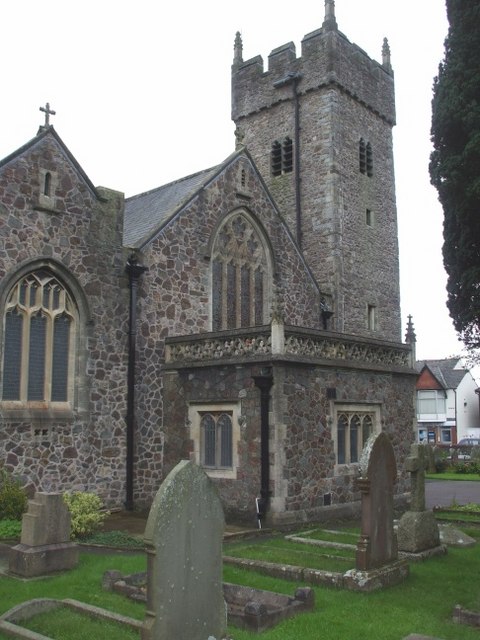
St Isans where John Wesley preached ‘repent and believe the Gospel’
In that photo you can see in the background some houses which are actually shops, just out of the picture and to the right is the upper flat / rooms where I got saved.
Photo courtesy of Mr John Lord, a Christian of many years.
At that time I was working on a dairy / mixed stock farm North of Llanishen, the farm was and is run by an Evangelical Christian family.
Being born again / anew back in early February 1984 was very exciting for me because God’s grace just invaded my life and within a short period of time I found myself a Christian.
God rides forth conquering in the chariot of his gospel; he conquers the pride of the heart, and makes the will, which stood out as a fort-royal, to yield and stoop to his grace; he makes the stony heart bleed .
Thomas Watson, non conformist Puritan
I was in much need, I was what you might call a broken young man, burnt out and given over to a host of vices from a misspent youth. Actually, misspent youth is an understatement, I was as wild as the mountain scenery.
God’s grace was quite irresistible because of it’s power and loveliness and yet at the same time I opened the door to Him who was knocking and that was after a period of time being convicted of my sin.
There was also an event ( which has proven an anchor for my soul ) about a week before I became a Christian and while being a wonderful thing it has also left me perplexed as to my response to it.
Behold, I stand at the door and knock. If anyone hears my voice and opens the door, I will come in to him and eat with him, and he with me.
Revelation 3:20 ESV
Hill farm where I was working at the time of my conversion …

Hill Farm Cotttage
Photo courtesy of Mr John Lord, a Christian of many years.
People argue a lot about the mechanics of Salvation, and while it is interesting to some extent I personally think it’s a wile of the devil and distracts many Christians ( including myself ) from what they should really be doing.
This next Scripture is to the people out there who think they know it all and have it all sussed out.
Oh, the depth of the riches and wisdom and knowledge of God!
How unsearchable are his judgments and how inscrutable his ways!
Paul’s letter to the Romans 11:33 ESV
That aside, I guess many people do not experience God like I did at that time and His grace in such a short space of time or in the way that I did. There was one event ( I mentioned earlier ) that I will never forget and is definitely in the realm of New Testament experience, maybe I will share it here one day but only if and when the time seems right to do so.
Afterwards though, ( after the Lune de Miel so to speak ) I made many mistakes, and trying to understand why I did so occupies a lot of my thoughts at the moment.
Being born anew / again involves in my opinion coming to the light;
“For everyone who does wicked things hates the light and does not come to the light, lest his works should be exposed. But whoever does what is true comes to the light, so that it may be clearly seen that his works have been carried out in God.”
Gospel of John 3:20-21 ESV
My understanding of the above Scripture is quite profound, because I can relate the Scripture in my own personal experience.
I have failed as a Christian in many ways and I have learned and am learning the hard way. Just like Israel I have been an untamed calf ( E’phraim, Jeremiah 31:18 ), also I have had to be harnessed with a bit and bridle to make me go in the right direction ( Psalm 32:9 ), wretched man that I am.
But I am not ashamed of being a Christian nor do I despise the discipline of God for it will bring forth the peaceable fruit of righteousness. ( Hebrews 12:11 )
I hope to use this web journal one day to convey the many thoughts that I have on various matters regarding Christianity and my experiences of it since being born anew and also before.
I remember at my baptism at Rhiwbina Baptist Church, Cardiff. South Wales ( where I subsequently received the right hand of fellowship ) … shortly after I was saved, saying to those in attendance the importance of Jesus Christ in this life, well, nothing has changed.
You must be born again! Repent and believe the Gospel!
I currently live in the foothills of the Hautes Pyrénées, France.